

For many years, Meta has been conducting research and development on EMG technology. The technology was initially made available to the public in 2025 by the firm in the form of its Meta Ray-Ban Display glasses. These glasses allow users to control them through the use of a specialized neural band that is able to recognize even the most minute muscle movements in the wrist.
Now, at the Consumer Electronics Show 2026 (CES 2026), the business is now providing its first glimpse at how its neural band could be utilized to manage gadgets that are not part of its smart glasses range. In order to investigate a number of exciting applications for its wrist-based controller, Meta has formed a partnership with Garmin, in addition to a few other research partnership organizations.
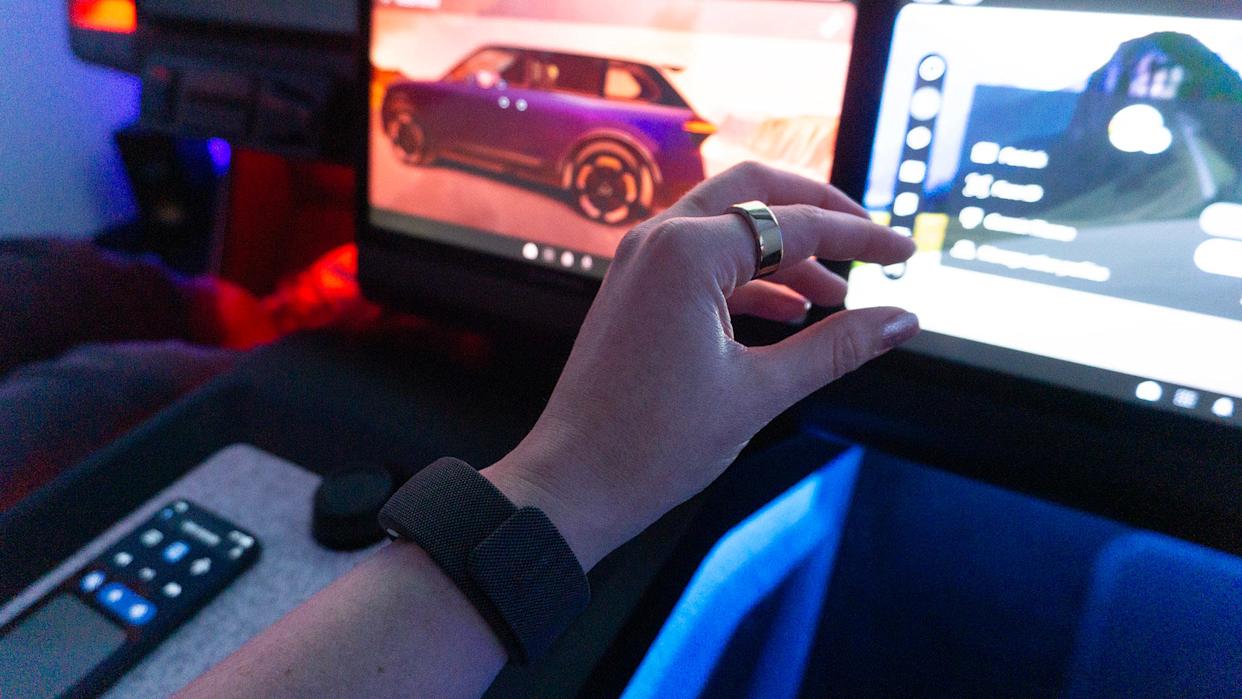
Formerly, the social media firm collaborated with Garmin on the development of fitness features for the company's spectacles. At the Consumer Electronics Show (CES), however, the businesses displayed a very preliminary demonstration of how Meta's neural band may be used to manage the built-in entertainment system of a vehicle.
The experience is a component of Garmin's "Unified Cabin" idea, which investigates a variety of in-car experiences that are centered on artificial intelligence. While wearing a neural band, I was able to navigate two apps on a touchscreen display in Garmin's cockpit configuration. The demo I tried was pretty limited in its capabilities. I was able to modify an on-screen model of an automobile by using pinch and swipe movements in one of them. This was quite similar to how I would use the band to zoom in and out of an image while wearing the display glasses. It was a game of 2048 that was the second demo, which was pretty peculiar. For the purpose of rearranging the tiles, I utilized the identical swipe gestures.
Neither of these are the kinds of experiences that come to mind when you think of "in-car entertainment," but Garmin, a company that collaborates with a number of major automobile manufacturers on infotainment systems, appears to be considering some more practical use cases as well. I was informed by the firm that it intends to investigate the possibility of utilizing the neural band to control operations of the vehicle, such as unlocking doors or rolling down windows.
In addition, Meta has announced that it would be collaborating with the University of Utah on a research project that will investigate the ways in which its electromyography (EMG) technology can be utilized to assist individuals who suffer from disorders such as amyotrophic lateral sclerosis (ALS), muscular dystrophy, and other conditions that impact their ability to use their hands.
The neural band will be used by researchers in collaboration with Meta to test movements that could enable consumers to control smart speakers, blinds, thermostats, locks, and other household gadgets. According to a blog post published by the firm, "Meta Neural Band is sensitive enough to detect subtle muscle activity in the wrist — even for people who are unable to move their hands." The researchers will also investigate the possibility of utilizing the band for mobility use cases, such as the TetraSki program at the University of Utah, which aids users in skiing by utilizing a joystick or a mouth-based controller at the present time.
